
The Vertical Drama Bubble Has Burst. Are We About to Watch It Happen All Over Again?
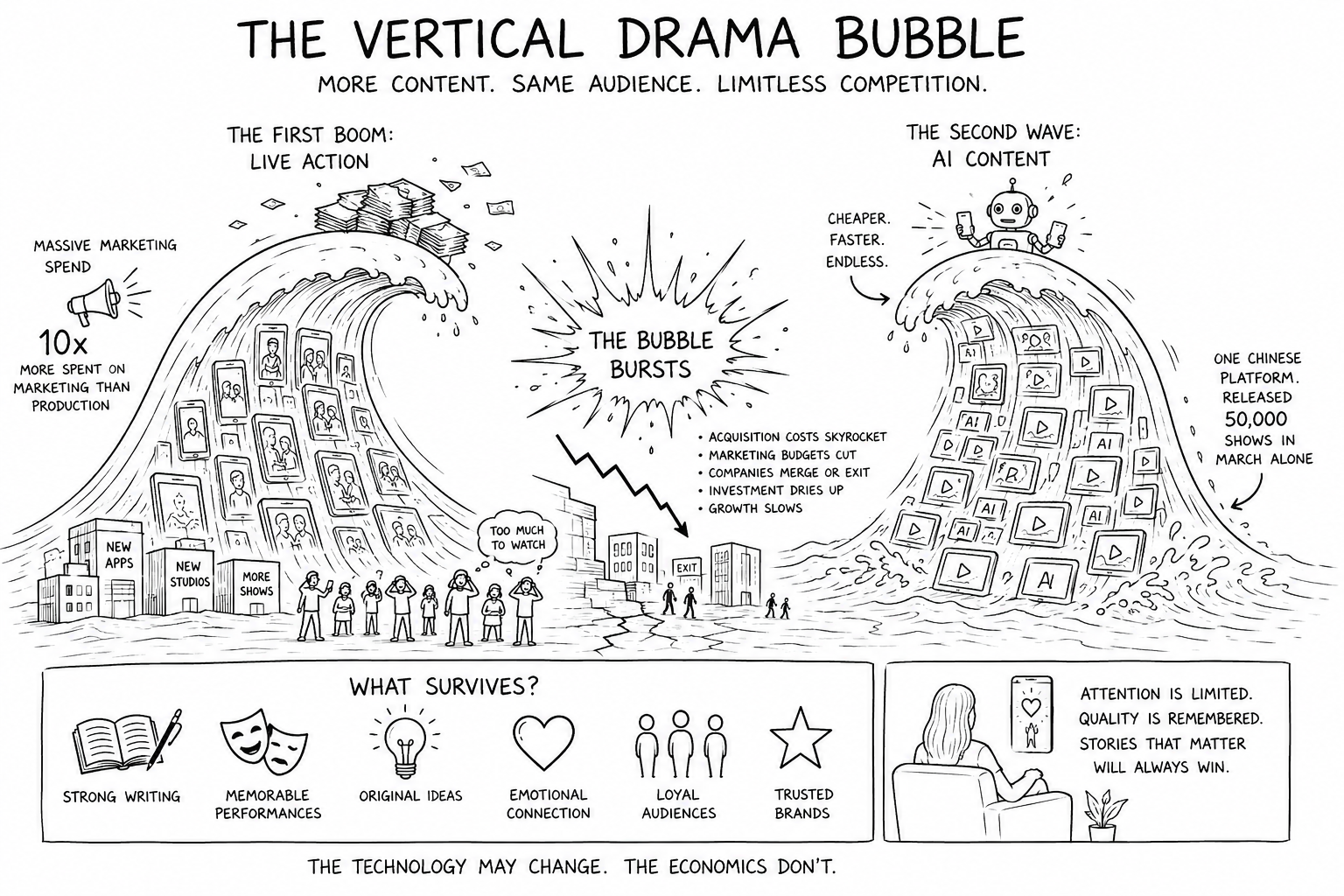
For the past few years, the vertical drama industry has felt unstoppable. New apps launched almost monthly. Studios expanded at incredible speed. Hundreds of new series appeared every week. Investment poured in, marketing budgets exploded, and everyone wanted a piece of what looked like the fastest-growing entertainment format in the world.
But if you strip away the excitement, what we've witnessed isn't unique. It's something economists have seen time and time again. It's called a bubble.
What is an economic bubble?
When most people hear the word "bubble", they think about house prices or the stock market.
But bubbles don't just happen to prices. They can happen when an industry grows faster than the market can realistically sustain.
In entertainment, the scarce resource isn't money. It's attention. Every viewer only has so many hours in the day. No matter how many platforms launch or how many dramas are released, nobody can create more time to watch them. If content grows faster than audience attention, eventually something has to give.
The first bubble: Live action
The first vertical drama boom was built around live-action production. Investment flooded into the industry. New studios appeared almost overnight, platforms expanded rapidly, and companies competed fiercely to become the market leader. The race wasn't just about making great shows. It was about acquiring users.
Industry figures have suggested that some companies were spending as much as ten times more on marketing than on actually producing the dramas themselves. Vast sums were poured into social media advertising and aggressive customer acquisition. The aim wasn't immediate profitability. It was growth.
If investors believed you could become the dominant platform, losses today could be justified by market dominance tomorrow. We've seen exactly the same strategy in industries from ride-sharing to music streaming. But eventually, reality catches up.
When attention becomes the battleground
As more platforms entered the market, everyone was competing for the same viewers. The amount of content exploded. Audience attention simply couldn’t keep up. As a keen fan myself I have been totally overwhelmed by the sheer amount of new shows and apps.
That's when the economics began to change.
Every advert had to be louder.
Every trailer had to be more shocking.
Every clip had to stop people scrolling.
Social media algorithms naturally reward engagement, and content that provokes a strong reaction often performs well in that environment. The result?
Increasingly sensational storylines.
Hyper-sexualisation.
"Vertical slop."
Graphic violence.
Pregnant women being beaten.
Sex toys waved around for shock value.
Scenes designed to generate outrage, clicks and comments rather than emotional connection. That isn't to say every vertical drama followed this path—far from it. There are outstanding writers, producers and actors creating genuinely compelling work. But when platforms are locked in a battle for attention, the commercial incentive can shift towards whatever grabs the audience fastest, particularly in advertising and promotional clips. The irony is that what makes someone stop scrolling isn't necessarily what makes them become a loyal fan.
The evidence is becoming difficult to ignore
We're already seeing the consequences. Live-action production in Los Angeles has slowed dramatically compared with the industry's explosive growth just a year ago. While some productions have moved overseas or been replaced by AI-led experimentation, many people working in the sector are reporting a significant reduction in opportunities.
Industry agent Tina Randolph Contogenis, who has worked extensively with actors in the vertical drama space, has estimated that around two-thirds of the work has disappeared compared with the peak of the boom.
No single statistic can capture the health of an entire industry, but taken alongside slowing production, tighter budgets and changing investment priorities, it paints a picture of a market that has moved beyond its rapid expansion phase. The gold rush is over. That doesn't mean vertical dramas are disappearing. It means the industry is changing.
The bubble has burst
Why? Well the economics has stopped making sense. Customer acquisition has became increasingly expensive. Marketing budgets became harder to justify. The market is saturated.
There was simply more content than audiences could realistically consume.
The first bubble has burst. Not because people stopped enjoying vertical dramas. But because the industry can no longer rely on spending its way to endless growth.
And now we're doing it again
Just as the live-action market began to correct, a new opportunity appeared. Artificial intelligence.
This time, the promise isn't cheaper marketing. It's cheaper production. AI dramatically reduces the cost and speed of creating content. For platforms trying to build enormous libraries of shows, the attraction is obvious. But it also creates the conditions for another bubble. If production becomes dramatically cheaper, then supply can increase at a pace that no audience could ever keep up with.
One Chinese platform reportedly released around 50,000 shows in March alone.
Fifty thousand. In one month. Whether that becomes the industry norm or not, it demonstrates just how quickly AI can flood an already crowded marketplace. The first bubble was fuelled by marketing. The second risks being fuelled by volume.
History tells us what happens next
Economics has seen this pattern before. When barriers to production fall, everyone produces more. Eventually, there is simply too much.
The correction arrives.
Some companies disappear.
Some merge.
Some pivot.
Investment becomes more cautious.
The businesses built on volume alone struggle.
The businesses built on something deeper survive.
At the same time, the quality bar is rising
Interestingly, another trend is happening alongside the rise of AI. American producers and studios from other territories are entering the vertical drama market in increasing numbers. Many are bringing experienced writers, directors, actors and production teams with them.
That competition isn't simply about producing more. It's about producing better. And that's where I think the future lies.
So what survives after the bubble bursts?
History suggests something surprising. When supply becomes almost unlimited, quality becomes more valuable—not less. If anyone can produce thousands of shows, then quantity is no longer a competitive advantage. Quality is.
The shows that survive are the ones audiences genuinely recommend to friends. The ones they think about days later. The ones with memorable performances, strong writing, original ideas, characters they care about. Authentic human creativity.
Technology will continue to evolve. AI will undoubtedly become part of the production process.
But if history teaches us anything, it's that flooding the market with more content has never been enough on its own. Attention remains finite. Trust is earned. And when the dust settles after every bubble, audiences still choose the stories that make them feel something.
The technology may change. The economics don't.