
Nerding Out: Storytelling in the Vertical World
In which author and newbie screenwriter Jo Kenrick (AKA Jo Cotterill) dissects vertical scriptwriting.
Did you learn the Story Mountain at school? Most people who’ve been through the UK education system will have seen the Story Mountain diagram at some point. It looks like this:
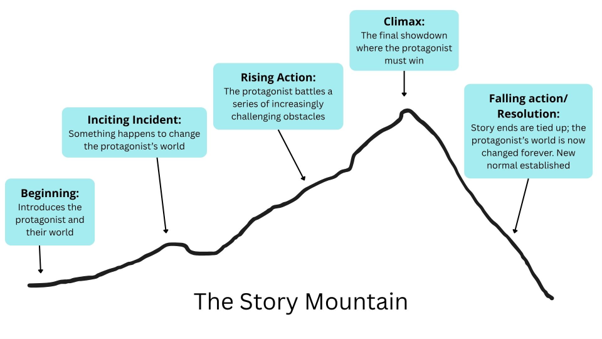
It’s a useful way to boil down a story structure to its simplest form, and it can be really helpful to teach kids who are learning how to tell a story.
Some people will have heard of Three Act Structure. That’s basically the Story Mountain, but divided into three unequal chunks: Act 1 is the introduction, ending with the inciting incident, Act 2 (the biggest chunk) covers the rising action up to the climax, and Act 3 does all the tidying up at the end.
Much of human storytelling works in exactly this way, from the anecdote you tell your family about your weird neighbour, to the Lord of The Rings.
But.
Vertical Storytelling is quite different.
In this first part of an occasional (and probably erratic) series for Vertical Drama Love, I’m going to look at microdrama storytelling and how it’s different from everything I’ve done before. Well, almost everything (more on that later).
Who am I?
I’m a UK children’s author with over fifty published books for ages ranging from 3 to 18. Writing a 45k novel for 8-12-year-olds is almost hardwired into me now, and although I’ve loved doing it for many years, I’d got stuck in a rut. I was tired and fed up, and had started to become interested in screenwriting for film and TV when, in early 2026, something happened:
I found vertical microdramas.
As everyone already hooked on verticals knows: these things are ADDICTIVE. Even when you’re not even all that into a story, you somehow can’t stop watching – and that’s because of the incredible storytelling machinery that’s pushing the drama along.
The vertical storytelling format is not like anything else: not TV, not film, not novels. It is completely unique in the way that it operates.
I was immediately hooked – not just on the experience of watching verticals, but on the way these stories are put together.
Since then, I have not stopped listening, reading and learning all I can about vertical screenwriting, and I’m going to share some of the things I’ve learned so far.
How Is a Vertical Microdrama Story Told?
Firstly, structure is ALL. If you’re an author writing a novel, you get to choose how long your chapters are depending on how they feel to you. Some authors write short chapters; others write several thousand words per chapter. If you’re writing a feature film, again, you can have quite long scenes if that’s what the story demands. A lot of the structure can be decided by the ebb and flow of pacing in the story. You can take five minutes of screen time for two characters to sit and chat while they look at the view, or a whole chapter of internal narrative while the main character ponders a decision.
The Idea of You (2024) in which one 4.45min scene between the two main characters involves him visiting her art gallery and buying all the art. It’s a flirty scene. In a standard microdrama, you could achieve the same in 90 seconds; there isn’t enough plot to sustain more than one episode.
In verticals, the entire premise is built on one aim: hook and keep the audience.
That means you mustn’t give your audience ANY reason to swipe away. Because time is money, and the more you watch, the more you pay. Dopamine hit after dopamine hit, and if your script doesn’t provide that, it won’t work.
The Mathematical Structure of Microdramas
Microdramas are divided into multiple episodes. They are individual slices of story: although there is a series arc, it matters less than the portions. They are a flow-chart of scenes:
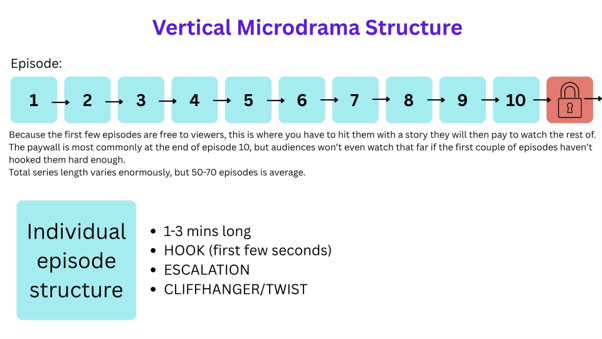
Episodes tend to band together in loops. For example, let’s say you have a scene in which the FL (female lead) is meeting the ML’s (Male Lead) family for the first time – and the family disapproves of her. This scene could easily last several minutes but be broken up into four or five episodes, as each member of the family accuses the FL of being a gold-digger, while she tries to defend herself. This loop of episodes explores one issue before we move on to the next loop where, for example, the FL and the ML are alone and she demands to know why he didn’t stand up for her, and passions rise until they kiss (or almost-kiss; an easy episode cliffhanger).
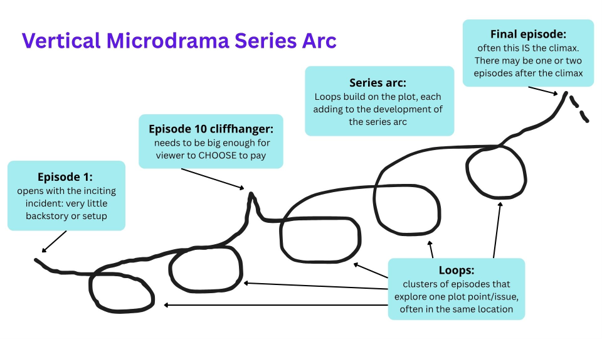
How Does This Actually Play Out?
In my next article, I’ll be analysing the first ten episodes of a microdrama series – you’re welcome to suggest which one! – to see how the story has to bend itself into the vertical format, and to consider how it might have played out more traditionally.
I’d like to end with a disclaimer: I am still new to vertical screenwriting and learning all the time. I’m currently attending the TikTok/Sundance Collab screenwriting course, reading Isabel Drean’s wonderful book ‘How To Write A Vertical Series in 10 Days’ and listening to multiple podcasts. If you’d like to suggest a correction or another resource for me, I’m grateful!
Writer - Jo Kenrick
This article is an opinion piece. The views and opinions expressed are solely those of the author and are based on the author's own observations and interpretation of publicly available content.
Publication by Vertical Drama Love does not constitute endorsement of every opinion expressed. Vertical Drama Love remains committed to encouraging thoughtful discussion on issues affecting the vertical drama industry while maintaining editorial independence.